
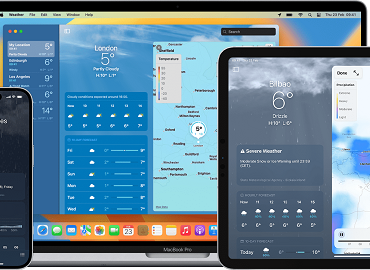
Why Should You Use an API for Your Weather App?
By Marc Berman
In today’s hyper-connected world, consumers expect a seamless experience for applications – and between applications. While the average person doesn’t understand the work that goes into developing an application and ensuring that it is compatible with other programs, they certainly notice when it is slow to update, inaccurate, or laggy. That’s why it’s essential that your business leads with API when developing any application, but especially those that rely upon big data and real time updates.
While APIs are incredibly helpful for nearly every app, from social media to shopping, they are a near-necessity for weather applications, as consumers have come to expect a high level of granularity in their forecasting. It’s no longer enough to give a general daily forecast, though customers do appreciate these: they want to be able to explore meteorological data in detail, from historical records to what the weather might be like several months from now. It is for these reasons, amongst numerous others we’ll explore today, that you should have an API for your weather app if you want to provide the best possible experience for your users.
With an API, you can lean on the expertise of countless other forecasters Most weather apps rely on federal or international services that collect thousands of data points over time, including the National Oceanic and Atmospheric Administration. These larger organizations have the resources to continually gather huge amounts of information that would be far out of the scope of the typical app developer – and you can leverage all of this data by utilizing an API that connects you to their resources. A great API will provide you with access to numerous high-quality datasets for both past and present, which you can then present to your customers in an attractive, well-designed application.
Using an API allows you to focus on your core features rather than data collection and management Designing any application isn’t easy, and it takes a great deal of skill to create a great product; this is why it’s essential that you pare down the time and energy you spend on anything but fleshing out your functionalities. As mentioned above, data collection and management is an extremely hefty task, one that could eat up a significant percentage of your resources. When the data is already existent and collated, why should you spend time gathering and organizing your own? By hooking your app up to an API, you can spend more time on designing a unique app offering that satisfies your audience.
APIs are very robust, guaranteeing good scalability There is nothing that destroys trust in an app quite like constant downtime and laggy data retrieval: it doesn’t matter how beautiful your interface is if users find themselves frustrated by its poor performance. That’s why APIs are incredibly helpful for weather apps, because they are designed to withstand heavy traffic without crashing. They also rely upon trusted weather information providers with quality infrastructure, which means that you can be assured of great performance when retrieving data.
You can provide historical and future forecasts that weather fanatics will love Lastly, let’s consider how your app can distinguish itself by providing a unique outlook: you may be
surprised at just how priceless historical weather data can be to some individuals, and how much they would deeply appreciate an “On This Day” component of your application. For example, a historical fiction writer might want to know what the weather was like on a certain significant day 50 years ago, but will struggle to find that information elsewhere. They would be delighted to realize that the app they rely upon for the daily forecast can give them that specific detail as well.
Many weather APIs include historical datasets that you can integrate into your application, with as much or as little specificity as you require. This could be exact day-and-time information, or simply general trends such as averages and historical highs or lows, depending on the audience for your app.
On the other end of the spectrum, future forecasting can be incredibly popular for those users who like to plan ahead. By utilizing historical forecasts, you can show your users the probable weather on any day in the future, giving them a clear image of what they should expect. This can be incredibly useful for the right consumer, and it will demonstrate the versatility of your product.
A weather app is only as good as its data In order to keep consumers using your program, you need to have prompt, accurate, and well-presented forecasting that users can rely upon to keep themselves safe. Given how expensive and time consuming it is to collect this information yourself, utilizing a reputable API will save you money and resources that can instead be spent improving the user experience. APIs are an invaluable ally to apps that rely upon big data, ensuring that you offer world-class service to your user base.
At its core, an API is a set of rules and protocols that allows one software application to interact with another. It acts as a messenger, taking requests from one application and delivering them to another, ensuring that the two systems can communicate effectively. APIs are the backbone of many digital services we use daily, from social media platforms to online shopping websites, and even the apps on our smartphones.
One of the most significant benefits of APIs is that they allow developers to build new applications and services without having to start from scratch. By leveraging existing APIs, developers can access a wealth of data and functionality, enabling them to create innovative solutions that enhance our digital experience. For example, a weather app can use an API to access real-time weather data from a third-party provider, while a travel booking website can use an API to search for available flights and hotels from various airlines and accommodation providers.
APIs also play a crucial role in enabling the integration of different software systems, which is essential for businesses operating in today’s digital environment. With the help of APIs, companies can connect their internal systems, such as customer relationship management (CRM) and enterprise resource planning (ERP) software, with external services like payment gateways and social media platforms. This integration allows businesses to streamline their operations, improve efficiency, and offer a more seamless experience to their customers.
Moreover, APIs have paved the way for the development of new business models and revenue streams. For instance, companies can monetize their APIs by offering them as a service to other businesses, enabling them to access valuable data and functionality. This has given rise to the concept of the API economy, where businesses build and leverage APIs to create new products, services, and market opportunities.
As the digital landscape continues to evolve, the importance of APIs is only set to grow. With the rise of emerging technologies like the Internet of Things (IoT), artificial intelligence (AI), and blockchain, APIs will play a critical role in connecting these technologies and enabling them to work together. For example, IoT devices can use APIs to send data to cloud-based platforms for analysis, while AI-powered chatbots can use APIs to access information from various sources to provide personalized recommendations to users.
Furthermore, as data privacy and security become increasingly important, APIs will need to adapt to ensure that they provide a secure and reliable means of communication between applications. This includes implementing robust authentication and authorization mechanisms, as well as ensuring that data is encrypted during transmission.
In conclusion, APIs have become an integral part of our digital world, acting as the bridge between applications and enabling seamless communication and data exchange between different software systems. As we continue to embrace new technologies and digital experiences, the role of APIs will only become more critical, shaping the way we interact with the digital world and driving innovation across various industries. By understanding the importance of APIs and harnessing their potential, businesses can unlock new opportunities and create a more connected, efficient, and innovative digital landscape.