
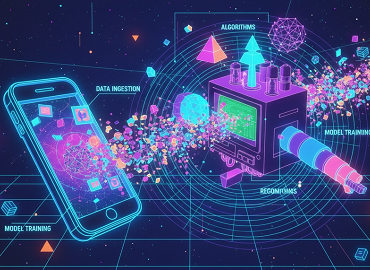
How to Build AI-Based Recommendation Systems in Mobile Apps: complete Guide for Developers
- Super User
Bankit Kumar
In 2026, AI-based recommendation systems are essential for improving user engagement and retention in mobile apps.Hybrid recommendation models combining collaborative and content-based filtering work best.On-device AI improves speed, privacy, and user trust compared to cloud-only models. AI-based recommendation systems make this possible.
Tools like TensorFlow Lite, Amazon Personalize, and Firebase ML simplify implementation.Successful recommendations focus on user satisfaction, context, and long-term behavior, not just clicks.In 2026, mobile users expect apps to feel personal from the very first interaction. Whether it is shopping, entertainment, fitness, or education, users want content that matches their interests instantly.
AI based recommendation systems make this possible.
This guide explains how recommendation systems work, which technologies to use, and how to implement them step by step in mobile apps without unnecessary complexity.
Why AI Recommendations Matter in 2026?
Mobile apps compete for attention in a crowded market. Users uninstall apps quickly if content feels irrelevant. AI-powered recommendations help apps stand out by showing the right content at the right time.
Recommendation systems improve:
User engagement and session time
Retention and repeat usage
Conversions and revenue
In 2026, personalization is not a premium feature. It is the baseline expectation. Apps that fail to personalize lose users to competitors that do.
The Rise of On-Device AI
On-device AI, also called Edge AI, has become a major trend due to growing privacy concerns and stricter data regulations. Instead of sending user data to cloud servers, models run directly on the mobile device.
Why On-Device AI Is Important
Faster performance: No network delay
Better privacy: Data stays on the phone
Lower cloud costs: Reduced server usage
Frameworks like TensorFlow Lite allow developers to deploy optimized machine learning models that work efficiently even on low-end smartphones.
What is Generative AI in Recommendation Systems?
Generative AI has changed how recommendations are presented.
“Recommended because you watched similar videos last night”
“Suggested based on your recent fitness goals”
This explanation builds trust and transparency. Users feel understood rather than manipulated, which increases acceptance and interaction with recommendations.
What are the Essential Tech Stack for AI Recommendations?
Choosing the right tools saves time, money, and development effort.
1.TensorFlow Lite
TensorFlow Lite is ideal for apps that require offline recommendations and full control over models.
Why developers use it:
Supports custom models
Works across Android and iOS
Optimized for mobile hardware
Limitation: Requires ML knowledge and careful optimization.
2.Amazon Personalize
Amazon Personalize is a managed service that handles data ingestion, training, and scaling automatically.
Best for:
Startups and MVPs
Teams without ML expertise
3.Firebase ML
Firebase ML fits well into Google’s mobile ecosystem.
Advantages:
Easy deployment
Built-in A/B testing
Free tier available
Limitation: Customization is limited compared to raw ML frameworks.
Step-by-Step: Building a Recommendation System
Step 1: Data Collection and Pre-processing
Data is the foundation of any AI system. Collect both:
Explicit feedback: ratings, likes, reviews
Implicit feedback: clicks, watch time, scroll behaviour
Implicit data is more reliable because it reflects real behaviour. Clean the data, remove duplicates, and normalize values before training models.
Step 2: Choosing the Right Filtering Method
There are three main approaches:
Collaborative Filtering: Uses behaviour of similar users
Content-Based Filtering: Uses item attributes
Hybrid Systems: Combines both approaches
Hybrid systems are the standard in 2026 because they handle new users better and adapt faster as behaviour changes.
Step 3: Model Training and Evaluation
Training involves feeding historical data into the model and minimizing prediction error. However, accuracy alone is not enough.
You must also evaluate:
Content diversity
Recommendation freshness
Long-term user satisfaction
Over-optimized systems that repeat similar content often lead to boredom and churn.
Step 4: Integration and Deployment
Most successful apps use a hybrid deployment strategy:
Lightweight models run on the device for instant recommendations
Larger models run in the cloud for daily or weekly suggestions
This approach balances speed, accuracy, and scalability.
Companies From which You can learn AI Recommendations 1.Netflix
Netflix uses thousands of micro-genres and personalized thumbnails. The recommendation system adapts across devices, ensuring continuity and relevance.
2.Spotify
Spotify focuses on context time of day, activity, and mood. Features like Daylist and Discover Weekly continuously update user preferences.
3.TikTok
TikTok’s interest graph tracks watch duration, replays, and completion rate. This allows the feed to change rapidly based on real-time behaviour.
Cost of Building AI Recommendation Systems in 2026
Basic system: $10,000–$50,000
Mid-level real-time system: $60,000–$250,000
Enterprise-grade systems: $500,000+ annually
Costs depend on data volume, model complexity, and infrastructure choices.
Common Challenges and Solutions Challenges
Cold Start Problem: New users lack data.
Data Privacy: Regulations limit data collection
Solutions
Ask for preferences during onboarding and show trending content initially.
Use on-device AI and privacy-preserving techniques like differential privacy.
Conclusion
AI-based recommendation systems are no longer optional in 2026 they define how users experience your app. Start with clean data, choose the right tools, and build gradually instead of trying to perfect everything at once.
Always focus on long-term user satisfaction rather than short-term clicks or views.
The most successful apps continuously learn and evolve with user behaviour. Regular testing, feedback loops, and model updates are essential to keep recommendations relevant.
As AI technology advances, apps that adapt quickly will gain a strong competitive advantage. In the end, great recommendations do not feel like algorithms, they feel like intuition.